The Romance of Engineering and Humanity's Endless Questioning
I. The "Endless Questioning" Triggered by "42"
Five days ago, at around 5:17 a.m. Beijing time on November 15, 2026 (4:17 p.m. local time on November 14 in the United States), at Pad 2 of the Starbase launch site in Boca Chica, Texas, a pair of mechanical arms — the "chopsticks" — caught Starship S42 as it returned from orbit for the first time.
It is a giant spacecraft with an empty weight of about 100 tonnes, which flew 14 orbits around the Earth, delivered 26 Starlink V3 satellites into space, and then re-entered the atmosphere enduring temperatures of about 1,400 degrees Celsius. The moment it was caught firmly by the two "chopsticks" on the launch tower, humanity for the first time closed the loop of "launch—deliver—return home" for a spacecraft, the way a bus pulls into its station.
What truly struck me, however, was the two lines of white letters printed on the side of the ship: DON'T PANIC S42.
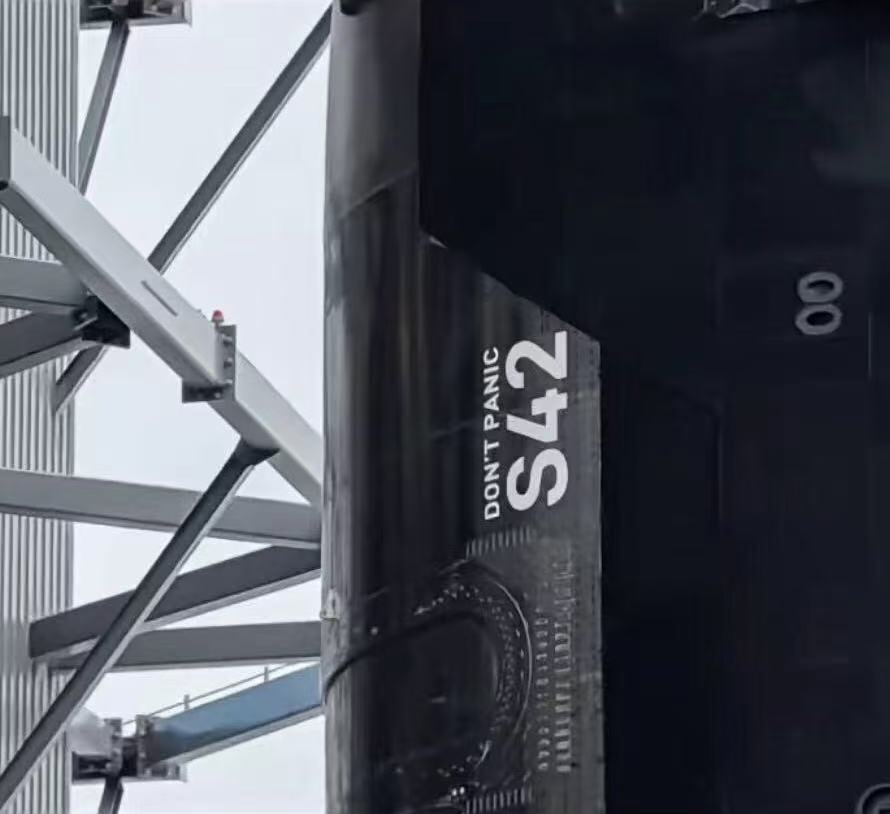
Anyone familiar with science fiction will recognize them at a glance: both come from The Hitchhiker's Guide to the Galaxy by the British writer Douglas Adams. "42" is "the Ultimate Answer to Life, the Universe, and Everything," computed by a supercomputer over 7.5 million years, while "DON'T PANIC" is the slogan printed on the cover of that fictional guide to the universe.
When I saw this image, I thought to myself that Musk — the great trickster — had planted another deep easter egg, because back in 2018, on the maiden flight of the Falcon Heavy, when he sent a Tesla Roadster into space inside the fairing, the car's center screen scrolled the words "DON'T PANIC".
I assumed that media outlets everywhere would catch this joke, especially since this time it came with the heavyweight "42".
Five days have passed. The overwhelming wave of "chopsticks catching a spaceship" coverage has already been replaced by news of Voyager 1 flying one light-day away from Earth, yet no one has bothered with that dazzling "42". As a severe obsessive-compulsive, I cannot stand it — such a deep, soul-stirring joke, and nobody noticed?
So I looked up the origin of the S42 designation. It turns out the number really is sequential — the "S" stands for Ship, and S41 was launched at 23:57 on September 28.
How could it be such a coincidence? Starship prototypes exploded on the test pad, exploded at the launch site, and exploded during recovery — and yet it was exactly on the one truly successful flight that the number "42" turned up. It is not superstition, yet it surpasses superstition — there is some hidden order in it: 42, this "Ultimate Answer".
Years ago, after The Hitchhiker's Guide became famous, someone asked Adams: "How did you come up with that 42?" Adams said there was nothing special about it — he simply wrote it down at random. This "S42" was likewise not deliberately arranged; it simply followed the sequential numbering. It was that kind of coincidence, a hidden "Ultimate Answer" — that the bright future of human civilization lies among the stars.
This brought to mind some unforgettable memories through which one can glimpse the soft feelings and cool intellectual aesthetics of the engineers and scientists — the "STEM straight men and women".
For example: "DARE MIGHTY THINGS" encoded in binary on the parachute of the Mars rover Perseverance, "JPL" written in Morse code into the tread of Curiosity's wheels, and "Are we alone?" engraved on Perseverance's deck.
Another: at lunch during an annual academic conference on deep-space exploration, the aerospace engineers sitting at my table ate while intently discussing the settings and plot of the science-fiction novel The Three-Body Problem.
Another: I can no longer recall when, but during a break at some conference, I chatted with Zhu Jin, then director of the Beijing Planetarium, about why they named one of the many asteroids they had discovered after Jin Yong — the great wuxia novelist.
Yet another: back when the Yang–Mills equations were first proposed, even though the authors knew there were unresolved problems, they still published them because "these equations are simply too beautiful" — they could not bear to discard them, and they left the remaining problems for the future to solve. Everyone knows what happened next: the equations became the foundation of the Standard Model, and the research built upon the Yang–Mills equations and related ideas went on to win five Nobel Prizes in Physics. Chen-Ning Yang always believed that a correct law of nature must be beautiful.
Beneath all this lies something shared by those who immerse themselves in the deep exploration of science and engineering, and in humanity's ultimate concerns: a curiosity, a romance, and an intuition for beauty that runs in their bones — an unspoken understanding and playful "hidden thought" that outsiders can hardly grasp, and above all a questioning and answering of those ancient questions: "Who am I?", "Where do I come from?", "Where am I going?", "How do I get there?"
II. A Thinking Reed
More than 300 years ago, the French philosopher Pascal gave a bleak answer.
"Man is only a reed, the weakest thing in nature; a breath, a drop of water is enough to kill him." There is nothing romantic in these words. Carl Sagan, on the other hand, in 1990 turned Voyager around after it passed Saturn's orbit, six billion kilometers from Earth, to take the famous "Pale Blue Dot" photograph — in which the Earth is a mere speck of light, less than a pixel, suspended in a beam of light like a mote of dust.
Sagan said: everyone you love, everyone you know, everyone you ever heard of, every human being who ever was, lived out their lives on that tiny dot.
Put these two statements together, and you have humanity's true situation in the universe: fragile, tiny, fleeting.
But what Pascal said next is the part that became most famous: even if the universe were to crush man, man would still be far nobler than that which kills him — because man knows he will die, while the universe knows nothing of it. Man is a thinking reed.
"All our dignity consists, then, in thought," Pascal wrote. "By space the universe encompasses and swallows me up like a point; by thought, I encompass the universe."
This is the key.
Humanity's nobility lies not in being anything but tiny, but in knowing its own tininess. However vast the universe, it does not know; the stone does not know; the reed does not know. Only humans look up and ask, "Why?" This single act of knowing lifts humanity out of the dust of the cosmos.
III. Endless Questioning: An Unstoppable "Disease"
To question endlessly for the sake of knowing is an unstoppable tenacity and strength — it is the innate nature of humans standing between heaven and earth.
Einstein called this refusal to stop "cosmic religious feeling." In The World As I See It, he wrote: "The most beautiful experience we can have is the mysterious... whoever no longer feels curiosity, no longer feels astonishment, is as good as a walking corpse, and his eyes are dimmed." He said it is precisely this awe and wonder before the universe that forms the birthplace of true science and art.
John Wheeler — the man who gave "black holes" their name — went even further. Late in life he proposed a thesis rarely understood by his contemporaries: "it from bit" — everything arises from bits — along with the "participatory universe." He believed that the observer is not a bystander to the universe but, through repeated acts of questioning, participates in creating the universe itself: "No phenomenon is a phenomenon until it is observed."
Newton's expression of "knowing" on his deathbed was: "I do not know how the world sees me, but to myself I am only a child playing on the seashore, now and then finding a smoother pebble or a prettier shell, while the great ocean of truth lay all undiscovered before me."
None of these people standing at the summit of human intellect felt that they "understood." On the contrary — the more they understood, the more they knew they did not understand. As Wheeler put it: "We live on an island surrounded by a sea of ignorance. As our island of knowledge grows, so does the shore of our ignorance."
"Endless questioning" is humanity knowing full well that it is tiny and helpless, and that the pursuit may well end without result, yet still stubbornly asking. For this endless questioning gives people hope.
In 2006, at the age of 95, Wheeler left in his diary the last sentence of his life, and his last question:
"Hope produces space and time?"
IV. Romance and the Search for Meaning
Let us return to those inscriptions on the spacecraft.
"DARE MIGHTY THINGS", "Are we alone?", "DON'T PANIC"...
Looking at them now, what are they?
They are not answers. They are all questions — questions humanity has still not answered. The engineers inscribed these questions into the hardest metal, one line of binary, one string of Morse, one slogan at a time, and sent them into space.
This is the deadly romance of the engineers and scientists.
Kant has a phrase quoted countless times, that two things fill the mind with ever-new and increasing awe: the starry heavens above, and the moral law within. These two are in fact the same thing — the starry sky is "what we are," and the moral law is "how we ought to live."
The parachute is for adjusting attitude and slowing descent, yet the engineers wove in "the coordinates of the laboratory" and "a life motto"; the wheel is for rolling over sand, yet they engraved their signatures in Morse code. Tools are for work, but on every tool they carved warmth and feeling.
More than 50 years ago, the British scientist James Lovelock, invited as a meteorologist to take part in NASA's lunar project, was inspired to a remarkable scientific insight: the life, atmosphere, oceans, and rocks of the Earth together form a self-regulating whole that keeps the planet in a state fit for life, and this whole is itself a living being. He gave this conjecture a complex, pedantic name: "a cybernetic system with homeostatic tendencies as detected by chemical anomalies in the Earth's atmosphere."
One day he was chatting with his neighbor, the novelist William Golding, about this conjecture. Golding was astonished: how could such a magnificent system bear such a mediocre name? Golding was the author of Lord of the Flies and the 1983 Nobel laureate in literature. By coincidence, both men had deliberately stepped out of "the system" — Golding had resigned his teaching post to write full-time, while Lovelock, unaffiliated with any university, supported himself through patented inventions. The two lived together in a small village called Bowerchalke in Wiltshire, England, and often strolled along the country lanes.
On one such lane, they talked about Lovelock's discovery. Golding's admiration took Lovelock by surprise, and he hurriedly asked Golding what name it should be given. Golding thought seriously, then said it must be "Gaia" — only "Gaia" was worthy of this great theory.
At first Lovelock did not catch on. He had no classical education and thought Golding meant "gyre," the great oceanic whirlpool — a circulation, a feedback, which seemed apt enough. It was not until Golding insisted "no, it's Gaia, the Earth goddess" that he suddenly understood.
You see, this is the same gesture as the engineers printing "42" on the spaceship — both reflect a search for ultimate meaning.
When an inventor's scientific philosophy collides with a writer's sensibility, the world gains a great scientific theory and a glow of humanism.
V. Dignity Lies Not in Finding the Answer
This reminds me of Liu Cixin's short science-fiction story "Chaowen Dao".
In the story, humanity builds a giant particle accelerator encircling the Earth, hoping to find the universe's grand unified theory. A representative of an alien civilization called the "Risk Taker" (Paixianzhe) appears to stop them, on the grounds that the experiment would trigger vacuum decay and destroy the entire universe. The Risk Taker already holds the universe's truth but, under the "principle of knowledge sealing," cannot reveal it to humanity. Under the scientists' desperate pleading, he erects a "Truth Altar": any scientist may ask one ultimate question and, upon receiving the answer, dissolve into a point of light.
And so, one after another, humanity's greatest physicists and mathematicians voluntarily ascend the altar, giving up their lives, only to know the answer in that single instant before death.
In the story, Hawking finally ascends the altar in his wheelchair and asks the question —
"What is the purpose of the universe?"
The sky is empty. The Truth Altar gives no answer, and the Risk Taker stands frozen.
This is the endgame of "endless questioning": some questions may never have an answer. But the act of asking itself is where humanity, as the universe's self-awakening being, finds its dignity and meaning.
Pascal said human dignity lies in thought; Kant said it lies in gazing at the starry sky while holding the moral law within; Wheeler said humans participate in creating the universe through questioning; and Liu Cixin, with a single line — "What is the purpose of the universe?" — presented the meaning of existence before a silent answer.
Just in these past couple of days, a new piece of news broke: Musk said that S42 is in good condition and could fly again with minor repairs — but it will not fly again. "Because what it did is historically significant, we do not plan to risk flying it again; it will be kept for public display."
A spaceship born for "reusability" is to be "enshrined." It carried the "42" — the Ultimate Answer — into the sky, circled the Earth 14 times, landed, and was then solemnly preserved for future generations to see — the first time humanity caught a spacecraft returning from orbit. Spaceships can be built again countless times, but "the first time" belongs to this one alone. Enshrining it, like the "42" printed on its hull, is a way of using the hard-nosed romance of engineering to solemnly carry those questions so serious that they have no answer.
So the next time you see a spaceship in the news, or a parachute, or a wheel leaving Morse code in the Martian sand, what you feel should not be merely "the engineers are having fun." It is a thinking reed, posing questions to the vast universe and answering them.
It is unimaginable how bleak life and human existence would become if one day the humans of this world stopped pondering meaning, stopped seeking answers, or could no longer find meaning.
I look forward to the day when I can view "S42" up close in a dedicated exhibition hall, preserved as an important historical artifact of human civilization, and pay tribute to the onward-marching Homo sapiens!